
Six Sigma
What is Six Sigma? | The Belts | DMAIC | LeanSIX SIGMA MICRO COURSES
For each section, there are several 5-minute micro-courses to help you understand the tools and techniques a bit better. Click on the + sign to view the courses. Take all of the courses in the phase and earn an electronic badge and certificate. Enjoy!

WHAT IS LEAN SIX SIGMA? 139
The Belts 140
The History of Lean, Six Sigma, and DMAIC 141
THE SIX SIGMA PROJECT LIFECYCLE: DMAIC 145
DEFINE
Take the Deep Dive Course with games and a quiz:
Define Deep Dive
MEASURE
Take the Measure Deep Dive Course with games and a quiz:
Measure Deep Dive
ANALYZE
IMPROVE
CONTROL
THE BELTS
Take the Six Sigma Belts Micro Course
| Six Sigma Belt | Avg. Annual Salary (US) | Typical Range |
|---|---|---|
| White Belt | $57,000 | $42,000 – $65,000 |
| Yellow Belt | $85,000 | $65,000 – $95,000 |
| Green Belt | $119,800 | $100,000 – $128,000 |
| Black Belt | $132,800 | $117,200 – $147,200 |
| Master Black Belt (MBB) | $180,400 | $154,000 – $215,000 |
THE WHITE BELT: Awareness-level literacy for anyone whose job touches a process.

THE YELLOW BELT: A functional working knowledge for people who own a process daily and support — or partially lead — small improvement efforts.

THE GREEN BELT: The most commonly requested credential in job postings is the ability to independently run a moderately complex improvement project part-time.

THE BLACK BELT Full-time process-improvement professionals who lead complex, cross-department projects and mentor Green Belts.
Certifying Bodies
You will want to learn and earn your certifications from certifying bodies that organizations trust and hold in value. There are many places to learn and certify your Six Sigma knowledge, but a few stand out from the rest.
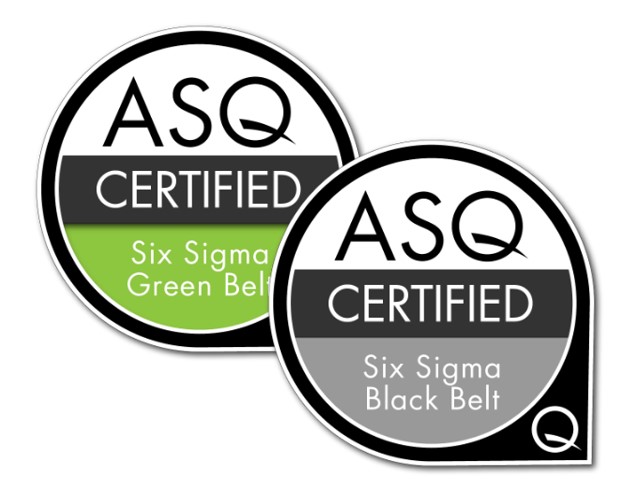
ASQ (American Society for Quality)
IASSC (International Association for Six Sigma Certification)
CSSC (Council for Six Sigma Certification)
SSGI (Six Sigma Global Institute)
| Factor | ASQ American Society for Quality |
IASSC Int’l Assoc. for Six Sigma Certification |
CSSC Council for Six Sigma Certification |
|---|---|---|---|
| Cost (per belt exam) | Highest: ~$394–$585 (Yellow–Black Belt); members save ~$100. No official White Belt. | Mid: ~$250–$450 per belt. No official White Belt. | Lowest: Free (White) to ~$99–$349 per belt, depending on standard vs. self-paced track. |
| Time to Completion | Longest: requires 2 signed project affidavits (or 1 project + 3 yrs experience) for Black Belt; Green Belt needs 3 yrs relevant work. Often several months to 1+ year. | Fastest: no prerequisites or project requirement — just study and pass a closed-book exam. Can be done in days to weeks. | Fast: open-book, online, self-paced exams with no project requirement for standard track; typically days to a few weeks. |
| Time in the Market | Oldest and most established: founded 1946 (as ASQC), added Six Sigma certifications later — longest overall track record of any quality body. | Founded 2009 — newer, but has been a standardized global exam provider for over 15 years. | Founded 2005 — the oldest of the “pure” Six Sigma certifying/accrediting bodies, predating IASSC. |
| Certified/Reached Individuals | Large, long-running base: 30,000+ active members in 140+ countries across all ASQ certifications (Six Sigma is one of many credentials it offers). | Smaller but exam-focused: 7,000+ IASSC-certified professionals reported by 2018, with steady growth since; works through ~60 accredited training partners. | Very high volume: founder reports 100,000+ individuals trained/certified historically; ~300 accredited training providers (roughly 4x IASSC’s network) across 165+ countries. |
| How Organizations View It | Considered the “gold standard”: ANSI-accredited, most rigorous, most respected in manufacturing, healthcare, and other regulated/traditional industries. | Well-regarded for standardized knowledge validation; popular in consulting and service industries, especially where speed and accessibility matter more than project proof. | Widely used by training providers and budget-conscious organizations; respected for accessibility and global reach, but generally seen as less rigorous than ASQ in traditional/regulated industries. |