
Course Process
Introduction — What Is Six Sigma and Why Does the Belt System Matter?
Six Sigma is a data-driven methodology for improving processes by identifying and removing the causes of defects and variation. The name comes from statistics: a process operating at “six sigma” produces only 3.4 defects per million opportunities — essentially near-perfect quality. Six Sigma is most often executed through the DMAIC framework (Define, Measure, Analyze, Improve, Control) to improve existing processes, or through DMADV/DFSS (Define, Measure, Analyze, Design, Verify) to design new ones.
To make this methodology teachable and scalable across an organization, practitioners borrowed the martial arts belt system — a tiered structure that signals a person’s depth of knowledge, hands-on experience, and leadership capability. This matters for three reasons:
- A common language. A “Green Belt” or “Black Belt” means roughly the same thing whether you’re in manufacturing, healthcare, finance, or IT — it tells a hiring manager or project sponsor exactly what skill level to expect.
- A career ladder. The belts create a clear progression path, from someone who simply understands the vocabulary (White Belt) to someone who designs enterprise-wide quality strategy (Master Black Belt).
- Right-sized involvement. Not everyone needs to run a statistical regression. The belt system lets organizations match the level of training to the level of responsibility — awareness for most employees, deep expertise for a select few full-time improvement specialists.
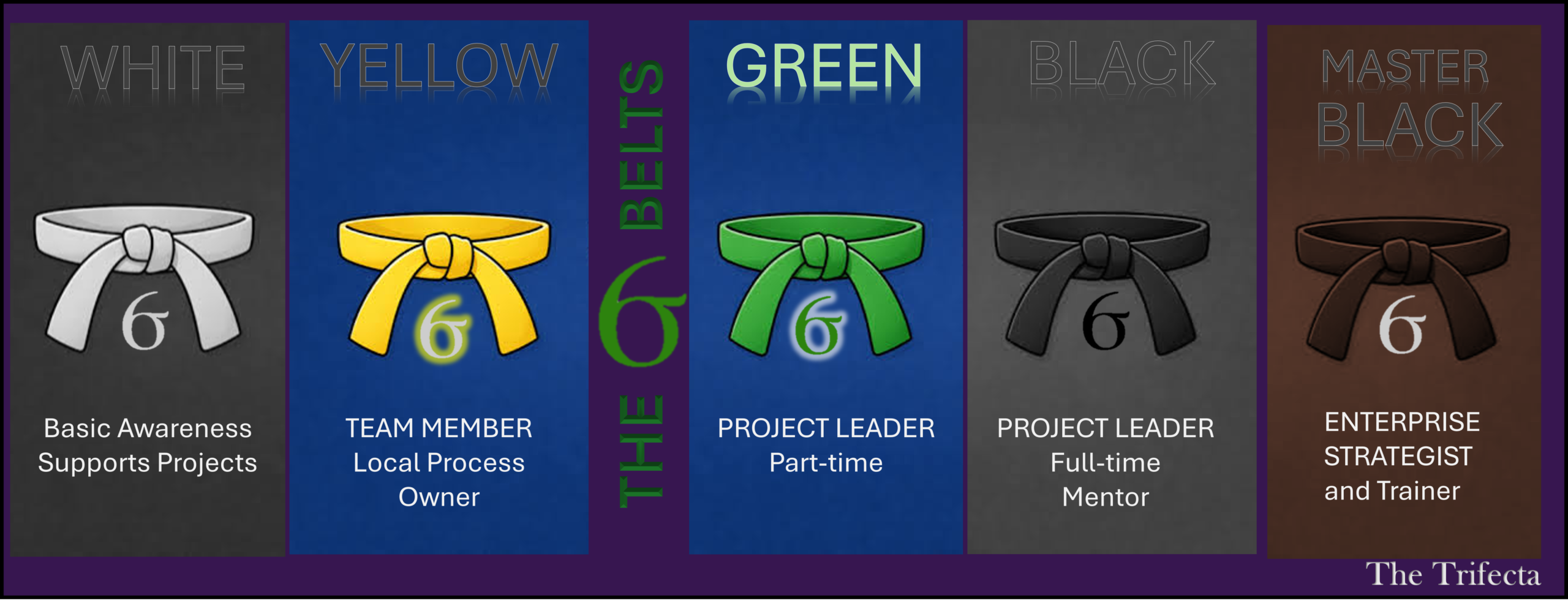
Here’s the belt hierarchy at a glance:
| Belt | Role | Typical Time Commitment | Depth of Statistics |
|---|---|---|---|
| White Belt | Basic awareness, supports projects | 1 day–1 week | None to minimal |
| Yellow Belt | Team member, local process owner | 1–3 weeks | Basic |
| Green Belt | Project leader (part-time) | 1–3 months | Intermediate |
| Black Belt | Full-time project leader/mentor | 4–6 months | Advanced |
| Master Black Belt | Enterprise strategist and trainer | Years of BB experience + certification |