Creating a Hybrid Project Plan
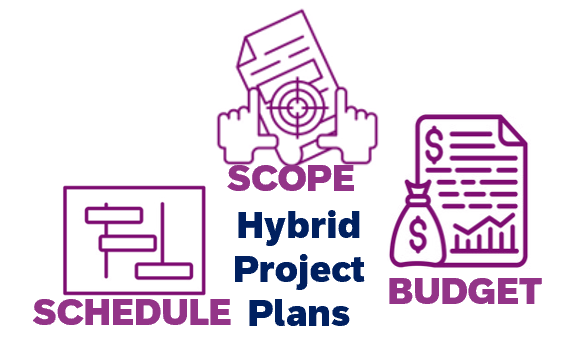
How you set up and run your projects will vary from project to project. As a project manager, you will need to know the best way to set up your project for success. A few questions about the classic “iron triangle” of scope, schedule, and budget usually point me in the right direction.
sc
- Is your scope fixed or fluid? Is it locked in, or is it going to move? Are the requirements fully fleshed out, or still kind of fuzzy?
- Are the requirements fully fleshed out?
- What is the size of the project (Stakeholders and schedule)? How big is this thing, really — stakeholders, timeline, all of it?
- What are the roles of the main Stakeholders? What roles are my main stakeholders playing? And how stable is my team — do I have dedicated people, or is everyone splitting time across five other projects?
- What is the stability of the resources (dedicated)?
- Do you have a contingency fund? Is there a contingency fund if things go sideways (because something always goes sideways)?
Here’s a fork in the road I hit at the start of pretty much every project: do I run this the traditional way, go full agile, or stitch together something in between?
Once you have answered these questions, the next step is to determine whether your project will follow a traditional or agile project flow.
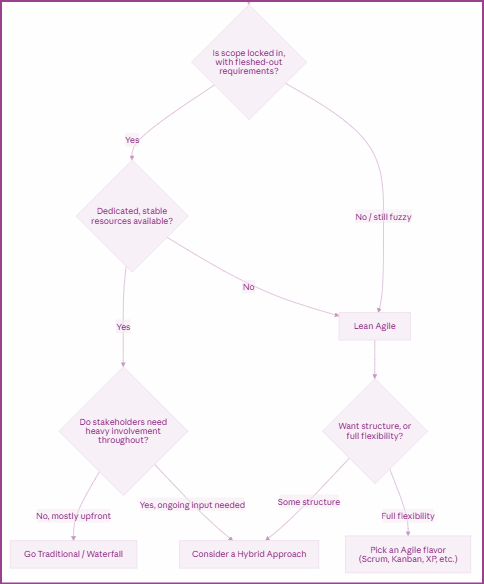
If the answer is traditional, there are elements that are in stone and unchangeable.
Traditional | Waterfall: When Things Need to Stay Put
Waterfall — also called the predictive or traditional method. During this process, one phase of project management must be completed before the next phase can begin. The five stages of the waterfall (predictive) method are all important and must be undertaken. PMBOK follows the traditional methods of Initiation, Planning, Execution, Monitoring & Controlling, and Project Close. If you choose to pursue your PMP (Project Management Institute’s Project Management Professional Certification), you will learn the phases and the work within each phase.
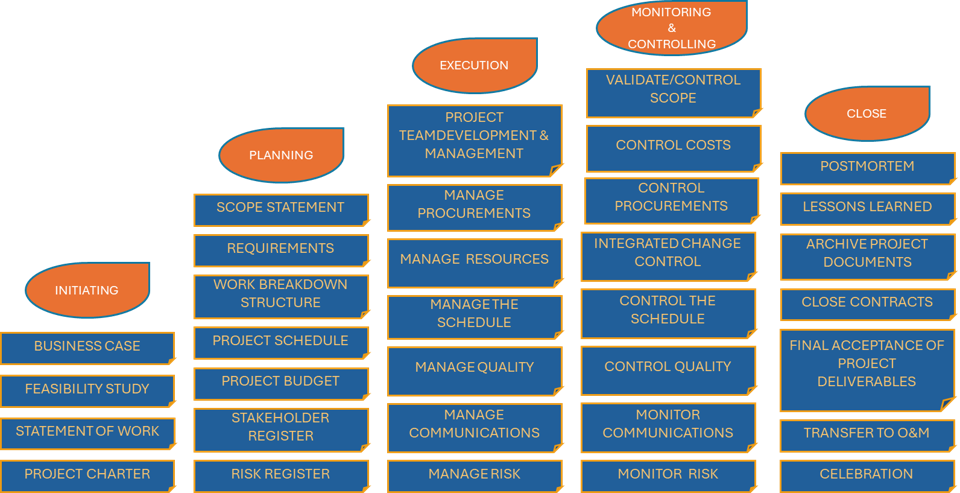
If the traditional approach is chosen, certain elements of the project MUST be completed in each phase, with planning being the most important. You are to pay close attention to all of the elements of this phase. I have found the most important artifacts to have buttoned up are the requirements, the schedule, and the budget. You will not be able to execute your project without a good handle on the work your team will be performing and when. In my experience, three things have to be buttoned up tight: requirements, schedule, and budget. I can’t run a project well without a real handle on what my team is building and when. And schedule and budget are basically the same conversation — every hour worked is money spent, whether that’s time, materials, or salaries. Skimp on planning, and I promise it comes back to bite you in every phase after.
Agile Approaches
On the other hand, you may choose a hybrid approach to managing your project. You have reviewed the traditional approach and found it has all the elements you require, but you may need some flexibility in certain areas. This is where creating a hybrid agile approach is appropriate. Some project managers make only small tweaks to the traditional approach, while others combine several agile approaches to structure their projects. Personally, I borrow pieces from all over this list. I lean on XP and FDD a lot for my IT projects — some of their ideas just click for that kind of work, and I’m glad my PMI-ACP training went deep on them.
For example, when you start to look at the different agile approaches, you find there are several to choose from:
- The Scrum Methodology is a framework within the agile methodology that structures the project management process, inspired by the scrum in rugby. The focus is on teamwork. How the team works, learns, fails, and succeeds as one.
- Major Certifying Bodies: Scrum Alliance (Certified ScrumMaster (CSM)), Scrum.org (Professional Scrum Master (PSM I, II, III)), and Project Management Institute (PMI) (PMI-ACP (Agile Certified Practitioner))
- Major Certifying Bodies: Scrum Alliance (Certified ScrumMaster (CSM)), Scrum.org (Professional Scrum Master (PSM I, II, III)), and Project Management Institute (PMI) (PMI-ACP (Agile Certified Practitioner))
- Using Kanban Methodology | The Agile Boards have been a popular method for managing projects for the past 10 to 15 years. It is a methodology for proactively managing the flow of project work from inception to delivery. Kanban (看板) is the Japanese word for “signboard”; in our case, a task board for project work.
- Major Certifying Bodies: Kanban University (Various Kanban Credentials), Scrum.org (Professional Scrum™ with Kanban Certification), ProKanban.org. and Kanbanstudy™.
- Major Certifying Bodies: Kanban University (Various Kanban Credentials), Scrum.org (Professional Scrum™ with Kanban Certification), ProKanban.org. and Kanbanstudy™.
- Extreme Programming (XP) is an agile software development framework that emphasizes engineering practices.
- Major Certifying Bodies: XPA Extreme Programming Alliance, NICCS National Initiative for Cybersecurity Careers and Studies (Certified Extreme Programming (XP) Professional (CXPP))
- Major Certifying Bodies: XPA Extreme Programming Alliance, NICCS National Initiative for Cybersecurity Careers and Studies (Certified Extreme Programming (XP) Professional (CXPP))
- Crystal Agile Methodology focuses on the individuals on the project team and how they interact with one another, rather than on the project management tools and techniques used.
- There is no dedicated, standalone certification body exclusively for the Crystal Agile Methodology, but it is officially covered under broad, multi-method Agile credentials from top institutions like the Project Management Institute (PMI) and foundational Agile groups like ICAgile
- There is no dedicated, standalone certification body exclusively for the Crystal Agile Methodology, but it is officially covered under broad, multi-method Agile credentials from top institutions like the Project Management Institute (PMI) and foundational Agile groups like ICAgile
- The Feature-Driven Development (FDD) Methodology is best suited for complex, long-term projects. FDD offers project teams flexibility and scalability by dividing feature sets into manageable parts through iterative work and releases.
- Feature-Driven Development (FDD) does not have large, standardized global certifying bodies or mass corporate accreditation institutes like Scrum or PMP do.
- Feature-Driven Development (FDD) does not have large, standardized global certifying bodies or mass corporate accreditation institutes like Scrum or PMP do.
- Dynamic Systems Development Method (DSDM) is an Agile method that focuses on the entire project lifecycle, created in January 1994 (the first version was completed in January 1995) by the DSDM Consortium (a non-profit) in the UK.
- Agile Business Consortium: The original creator and custodian of DSDM (founded in 1994 as the DSDM Consortium), which sets the official standards, curriculum, and evolution of the framework.
- Agile Business Consortium: The original creator and custodian of DSDM (founded in 1994 as the DSDM Consortium), which sets the official standards, curriculum, and evolution of the framework.
- The focus of Adaptive Project Framework (APF) is adapting to changing requirements, environments, and client and stakeholder needs. This is a unique project methodology based on systematic client control over project details.
- There is no single official or universally recognized standalone certifying body dedicated exclusively to the Adaptive Project Framework (APF), as the methodology—pioneered by Robert K. Wysocki—is generally taught as part of broader flexible or agile project management curricula rather than an exclusive proprietary certification.
- There is no single official or universally recognized standalone certifying body dedicated exclusively to the Adaptive Project Framework (APF), as the methodology—pioneered by Robert K. Wysocki—is generally taught as part of broader flexible or agile project management curricula rather than an exclusive proprietary certification.
I have created many agile projects, borrowing the relevant pieces from each of these agile methodologies. If you decide to go with an agile approach, I implore you to diligently develop a solid plan. Many times, projects using agile approaches become confusing because we think that not using the waterfall or traditional approach means we don’t have to plan well and can start moving through the project by the seat of our pants.
The best way to begin creating hybrid agile projects is to first know what is out there. Study not only Scrum, the most popular, but also other lesser-known project management approaches. Don’t stop at Scrum just because it’s the popular kid — spend time with lesser-known frameworks, too. I’ve found genuine gems hiding in Kanban’s flow-focused approach, DSDM’s lifecycle view, and APF’s client-driven adaptability — pieces that fit a project better than anything off-the-shelf.
I hope that it gave you insight into creating a Hybrid Project Plan!


About Post Author
